 FIN-TECHAI
The risk layer for on-chain finance
AI risk infrastructure for institutions settling value on public blockchains — and the $FTAI token that pays for it.
Contents
- 01Important notice
- 02Abstract
- 03The problem
- 04Design principles
- 05System architecture
- 06The four modules
- 07Scoring methodology
- 08Chain coverage
- 09Security and operations
- 10The $FTAI token
- 11Supply and allocation
- 12Vesting and release
- 13Presale structure
- 14Governance
- 15Roadmap
- 16Risk factors
- 17Glossary
01 · Important notice
This document is published for information only. It is not a prospectus, offering memorandum, or invitation to invest, and it has not been reviewed or approved by any regulator. Nothing in it is financial, investment, legal, tax or accounting advice, and nothing in it is a recommendation to acquire, hold or dispose of any digital asset.
$FTAI is a utility token. It is the means of payment for access to the FIN-TECHAI risk layer and for the governance rights described in section 14. It confers no ownership interest in Fin-techAI Foundation, no entitlement to profits, dividends, revenue, interest or liquidation proceeds, and no claim against any entity or asset. $FTAI has not been registered under the US Securities Act of 1933 or under any state securities law; where it is offered to US persons it is offered only under an available exemption and only to persons who meet the applicable investor standard.
Forward-looking statements in this document — including the roadmap in section 15 — describe present intent, not commitments. Features, timing, coverage and third-party integrations may change or may not be delivered. Commercial figures other than total supply are indicative and remain subject to the final approved sale sheet.
Participation is governed by the terms of service, whose clause 11 contains the full risk disclosure, and by the privacy policy. Read both in full before contributing. Digital assets are volatile; you may lose the entire value of your contribution. Contribute only what you can afford to lose entirely.
Abstract
Public blockchains settle value faster and more cheaply than correspondent banking, and they do it without the risk apparatus that made correspondent banking usable by regulated institutions. FIN-TECHAI builds that missing apparatus.
Four production modules read public chain data and return risk signals an institution can act on: Sentinel for screening and transaction monitoring, CreditGraph for repayment signals where no credit file exists, PayRoute for settlement routing that prices risk alongside cost, and Ledger Mind for reconciliation and evidence. All four are live today across seven networks.
Three commitments distinguish the design. Every output carries a confidence band, so an integrator can tell a strong finding from a weak one. Every output carries its contributing factors, so a decision made with our signal can be explained afterwards by the customer, to their regulator, without us in the room. And no output is ever presented as a verdict about a person — a score is an input to a policy the customer owns.
$FTAI is the settlement asset for that access. Usage of the risk layer is priced in $FTAI, holders govern the parameters described in section 14, and the token's supply is fixed at 1,000,000,000 units by the token contract. Sections 10 to 13 set out utility, supply, release schedule and the presale.
The problem
On-chain settlement removed the intermediaries. It also removed everything those intermediaries were doing that nobody had priced.
Settlement improved; diligence did not
Blockchain settlement collapses a multi-day correspondent chain into seconds, and all-in costs on on-chain rails commonly land between 0.1% and 0.5% against the 2–7% a traditional wire genuinely costs once fees, FX spread and intermediary deductions are counted. That gap is why institutional volume moved.
What did not move with it is the layer of judgement a correspondent bank supplied: knowing who the counterparty is, whether the funds are clean, whether the receiving institution has controls, and whether a payment should be made at all. On a public chain that judgement is technically possible — the entire history is public — and practically absent, because the data is unlabelled, cross-chain, and adversarial.
Three concrete failures
Screening happens too late. Many programmes screen after settlement, which produces an incident report rather than a control. A sanctions breach is strict liability in most jurisdictions; discovering it afterwards does not cure it.
Monitoring rules are inherited, not designed. Rules ported from wire-fraud systems fire constantly on benign on-chain behaviour — market-maker rebalancing looks like structuring, a bridge contract looks like a high-velocity counterparty — while missing the typologies that matter. Legacy rule sets routinely run above 90% false positives, and a queue nobody can clear is a control that is not operating.
Credit has no file to pull. Lending against on-chain collateral means underwriting counterparties with no bureau record, no income statement, and the permanent ability to start again at a fresh address.
Why a shared layer
Each of these is solvable in-house, and each is solved badly in-house, because the expensive part is not the model — it is the ingestion, normalisation and attribution work underneath it, replicated per firm at enormous duplicated cost. A shared risk layer amortises that work and, more importantly, improves with aggregate coverage: a typology observed at one customer strengthens detection for all of them, without any customer's data being disclosed to another.
Design principles
Four constraints shaped every part of the system, and each rules out a design that would otherwise have been easier to build.
1. A signal, never a verdict
Outputs describe addresses and transactions, not people. No output is a determination of wrongdoing, and neither we nor our customers may present one as such. This is partly an ethical position and partly a legal one: where an automated process produces a consequential outcome for an individual, that individual is frequently entitled to an explanation and to human review.
2. Confidence is part of the output
A score with no stated confidence is an assertion. Thin history, young coverage on a network, and low-certainty attribution all widen the band rather than being hidden inside a single number. A score of 72 at high confidence and a score of 72 at low confidence are different findings and must not trigger the same action.
3. Explainability is a deliverable, not a feature
Every response carries its contributing factors, the attribution source behind each, and the list versions queried. A customer must be able to reconstruct why a payment cleared or an alert fired two years later, from their own records, without us.
4. Exposure is a gradient
Direct receipt from a sanctioned address is a fact about a counterparty; a five-hop path to the same address is a fact about network connectivity. Every exposure finding carries hop distance and share of value, because collapsing them into a boolean is the single largest manufacturer of false positives in this category.
System architecture
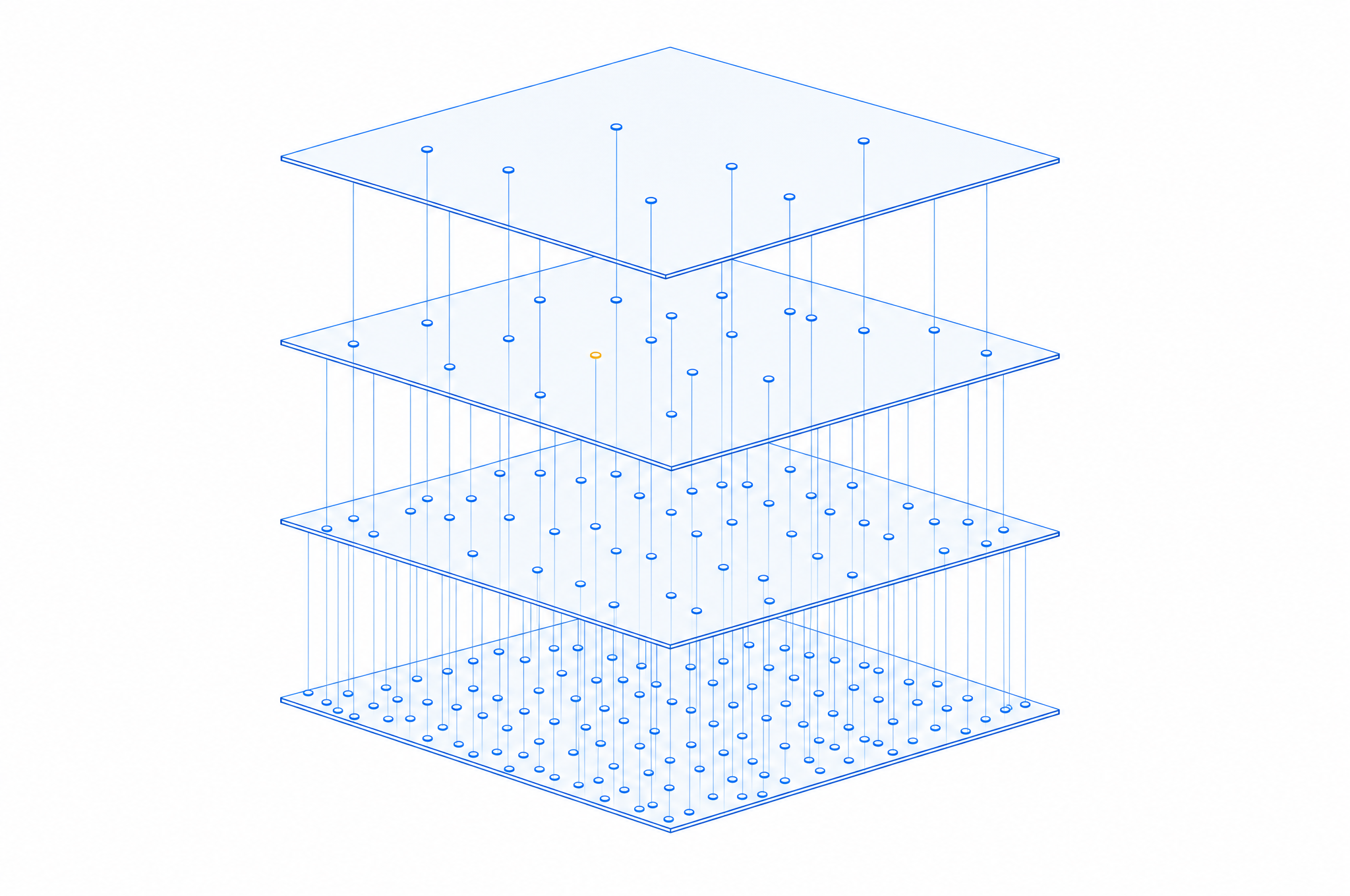
The system is deliberately boring in shape: ingest, normalise, build a graph, score the graph, serve the score. The engineering value is concentrated in the second and third stages, which is where most implementations are weakest.
Separating ingestion from scoring
Coverage started on EVM chains, which share an execution model: one ingestion path, one log format, one way to trace a token transfer. Solana broke that assumption, and the fix was to split ingestion from scoring entirely. The benefit is that adding a network widens the graph the models read without changing what a score means — which matters to any customer with thresholds tuned against it.
Normalisation is where correctness is won or lost
Two examples of why this stage carries the risk. Tron permits resource delegation, so one account can pay another's costs; a tracer that reads "paid the fees" as evidence of common control will merge a service and all of its users into one cluster, and every signal computed over that cluster is meaningless. Separately, a Tron address has a hex form whose tail is indistinguishable from an EVM address, so a naive identifier space serves an Ethereum verdict for a Tron transfer. Every identifier in our graph is namespaced by chain, and delegation is a distinct edge type weighted separately from value flow.
Serving and evidence
The API layer is designed around one requirement that shapes everything else: the response is the customer's evidence. Every response therefore carries a trace identifier, the list versions queried, and per-finding attribution and confidence, and is intended to be persisted whole rather than reduced to a decision. A customer who stores only "score 34, threshold 40, allowed" has a policy statement; a customer who stores the response has a record.
The four modules
All four are in production today. Each answers a different question against the same graph.
6.1 Sentinel — screening and monitoring
Sentinel screens addresses and transactions before value moves, and monitors flow continuously afterwards. It resolves sanctions and watchlist matches, attributes counterparties to services, and measures exposure to mixers, darknet clusters and known ransomware addresses with hop distance and value share attached to every finding.
Detection runs on typologies specific to virtual assets: layering across fresh addresses, chain-hopping through bridges and swaps, mixer exposure, structuring below reporting thresholds, and interaction with services that have weak or absent controls. Re-screening runs on a risk-banded schedule and on trigger events — a list update, a new attribution on any cluster in a customer's graph, adverse media, or a material shift against the customer's own behavioural baseline.
6.2 CreditGraph — repayment signals
CreditGraph produces a repayment signal for addresses with no off-chain credit file. The strongest single input is behaviour under stress: what an address did during a sharp drawdown with liquidation close, which is recorded permanently and timestamped for anyone to read. Collateral provenance is the second — whether assets were held for a year or acquired through a loop or a related-address transfer minutes before credit was drawn, a distinction invisible in a balance snapshot.
A thin address is scored unknown with a wide band, never bad. Conflating absence of evidence with evidence of poor credit is the most common error in on-chain underwriting, and the model is built to refuse it.
6.3 PayRoute — settlement routing
PayRoute selects a settlement corridor — the full path from the payer's asset and chain to the payee's, including the converting venue, the rail that moves value, and the endpoint that settles into local currency. It scores every hop and chooses against a policy the customer sets, optimising for all-in cost including slippage, time to final settlement rather than first confirmation, and counterparty risk at each hop.
When no acceptable corridor is available, PayRoute holds the payment and reports why, surfacing each rejected alternative with its reason. It never silently falls back to a route the policy would have rejected. Every decision retains the full candidate set, which is the field that tells an auditor whether the policy was working rather than merely what happened.
6.4 Ledger Mind — reconciliation and evidence
Ledger Mind reconciles on-chain movement against a customer's internal ledger and assembles the evidentiary record the other three modules generate: alert disposition and rationale, reviewer identity, policy version in force, and the full response bodies behind each decision, held immutably for the applicable record-keeping period.
Scoring methodology
Inputs
Every score derives from public chain history: address age, the shape of the funding graph, hop distance to sanctioned or exploited clusters, the mix of contracts and services interacted with, and behavioural similarity to addresses later found to be involved in theft or laundering. No input is decisive alone. A new address is not suspicious for being new; every address was new once, and legitimate users create fresh addresses constantly for sound privacy reasons.
Output shape
| Field | Meaning | Why it is exposed |
|---|---|---|
| score | 0–100 exposure summary | Comparable across addresses and over time |
| confidence | Certainty of the estimate | Distinguishes a strong finding from a thin one |
| exposure[] | Category, hop distance, value share, source, per-finding confidence | Lets policy treat direct and indirect exposure differently |
| sanctions | Match, lists checked, list versions | Proves what was live at the moment of screening |
| factors[] | Contributing factors behind the score | Makes the decision explainable after the fact |
| trace_id | Immutable reference | Ties the response to the customer's own audit record |
Reading the bands
| Score | Confidence | Reasonable action |
|---|---|---|
| High | High | Block or hold — the evidence supports a decision |
| High | Low | Review; do not auto-block. Thin history inflates volatility |
| Low | High | Proceed, and record the basis |
| Low | Low | Proceed with a tighter re-screening interval |
A new address with no exposure scores low because there is nothing yet to see — not because it has been examined and cleared. Absence of evidence is not evidence of absence, and the confidence band is where that distinction is carried.
Why scores move
A score is a property of an address at a point in time, not of the address. It changes when new flow arrives, when an attribution is published on a cluster the address touches, when a counterparty is designated, or when a model is retrained — any of which can move a score while the address itself does nothing. The operational consequence for integrators is that a cached score is not a screening result: enrichment may be cached for hours, a score for minutes, and a sanctions determination for seconds or not at all.
Chain coverage
Seven networks are in production. Coverage is not the same as parity, and the output says which is which.
| Network | Class | Why it is covered |
|---|---|---|
| Ethereum | EVM L1 | Deepest attribution history; reference implementation |
| Base | EVM L2 | High institutional and consumer payment volume |
| Arbitrum | EVM L2 | Concentrated lending and derivatives activity |
| Optimism | EVM L2 | Shared bridge topology with the wider superchain |
| Polygon | EVM | Enterprise payment corridors |
| Solana | Non-EVM | Sub-second finality; distinct account model |
| Tron | Non-EVM | Large share of stablecoin volume that never touches an EVM chain |
Heuristics tuned on years of EVM history are younger on Solana and Tron, and the confidence band widens accordingly rather than implying a precision that has not been earned. The question worth asking of any analytics provider, including this one, is not whether a chain is covered but what the confidence distribution on that chain looks like against Ethereum, and how long it has been in production.
Cross-chain tracing resolves automatically where a flow crosses networks. This matters because illicit actors rarely stay on one chain — value moves through bridges, swaps and privacy tooling in minutes — and a stack that leaves an analyst manually stitching hops together has coverage on paper only.
Security and operations
Treasury control
Treasury funds sit behind a multi-signature wallet. No single key can move value and no single person holds enough keys to reach the threshold alone; signers are separated by role and by device, so compromising one workstation does not compromise a quorum. Signer and device diversity is treated as seriously as signer count — five signers on identical hardware, firmware and machine images is a single point of failure wearing a quorum's clothing.
Movements fall into three classes, each with a different path:
| Class | Trigger | Requirement | Visibility |
|---|---|---|---|
| Operational | Budgeted, recurring, under ceiling | Quorum | On-chain after execution |
| Discretionary | Over ceiling, or a first-time destination | Quorum + timelock | Visible before execution |
| Structural | Signer set, threshold or timelock change | Quorum + longest timelock | Announced in advance |
The first-time-destination trigger does disproportionate work: most treasury losses are not exotic cryptographic failures but payments to an address that looked right. A timelock does not prevent a malicious transaction — it makes one visible while there is still time to react, which is only a control if queued transactions are alerted on, reviewed by a named owner, and cancellable through a rehearsed procedure.
Platform security
Encryption in transit and at rest, least-privilege access control, multi-factor authentication on administrative systems, network segregation, logging and monitoring, and periodic penetration testing and review. Where a breach is likely to risk individuals' rights, the applicable supervisory authority is notified within 72 hours of becoming aware and affected users without undue delay.
Audit and published artefacts
A smart-contract audit engagement is signed with CertiK; the report is not yet issued. Contract addresses, the treasury multisig address, the signing threshold, the liquidity-lock record and the audit report URL are all published only from the deployment receipts and the auditor's final report. Until those artefacts exist, this document states them as pending rather than filling them, because a wrong address sends contributions somewhere nobody controls and a fabricated audit link is a false safety claim.
The $FTAI token
$FTAI is the settlement asset for access to the risk layer. Its demand is a function of usage, not of narrative.
Utility
- Metered access
- API consumption across all four modules is priced and settled in $FTAI. Screening calls, scoring calls, routing decisions and reconciliation jobs each carry a unit price set by the parameters in section 14.
- Access tiers
- Held balance determines rate limits, re-screening frequency, cross-chain trace depth and evidence retention beyond the statutory minimum.
- Governance
- Holders vote on the parameter set described in section 14, weighted by held balance and subject to the participation floor set there.
- Model contribution
- Typology submissions and attribution corrections that survive review are rewarded from the community allocation, which is how coverage improves faster than a single team could drive it.
Token facts
| Name | FIN-TECHAI |
| Symbol | FTAI |
| Total supply | 1,000,000,000 |
| Supply policy | Fixed at deployment. No mint function; no inflation |
| Contribution assets | ETH on Ethereum, SOL on Solana, TRX on Tron |
| Token launch | 15 October 2026 (target, not a commitment) |
| Token contract | Publishing at token deployment |
| Vesting contract | Publishing at token deployment |
Total supply is fixed by the token contract and is the one commercial figure in this document that is settled. Everything in sections 11 to 13 is indicative and subject to the final approved sale sheet.
Supply and allocation
| Allocation | Share | $FTAI | Purpose |
|---|---|---|---|
| Ecosystem & liquidity | 20% | 200,000,000 | Exchange liquidity, integration grants, market operations |
| Treasury | 18% | 180,000,000 | Operating runway under the controls in section 9 |
| Team & contributors | 17% | 170,000,000 | Long-term alignment; 12-month cliff |
| Research & models | 15% | 150,000,000 | Data acquisition, model development, coverage expansion |
| Community & governance | 12% | 120,000,000 | Typology contributions, governance participation, rewards |
| Presale | 10% | 100,000,000 | Staged sale described in section 13 |
| Advisors & partners | 8% | 80,000,000 | Distribution and regulatory advisory |
| Total | 100% | 1,000,000,000 |
Total supply is fixed. The allocation split above, all stage prices, and the caps in section 13 are indicative examples pending the final approved sale sheet, and must not be relied on as agreed terms.
Vesting and release
Release schedules exist to make the float predictable. All schedules are enforced by the vesting contract, not by policy.
| Allocation | Cliff | Release |
|---|---|---|
| Presale | None | 25% at token launch; remaining 75% in three equal quarterly instalments over the following nine months |
| Team & contributors | 12 months | 36 months linear thereafter |
| Advisors & partners | 6 months | 24 months linear thereafter |
| Research & models | None | 48 months linear |
| Ecosystem & liquidity | None | 30% at launch for initial liquidity; remainder against published milestones |
| Community & governance | None | Emitted per epoch against a published schedule |
| Treasury | None | Unlocked; movement constrained by the transaction classes in section 9 |
Claim mechanics
Contributing gives an entitlement to $FTAI, not immediate delivery. Tokens become claimable at token launch through the published claim interface, and are claimed from the same wallet that made the contribution — an entitlement cannot be reassigned to a different wallet. Unclaimed entitlements remain claimable for twelve months from token launch, after which they may return to the treasury.
Transfer restrictions
Until an entitlement has vested it may not be sold, pledged, assigned or otherwise transferred. Where tokens are sold to US persons under a securities-law exemption they are restricted securities for US law purposes, may not be resold except pursuant to registration or an available exemption, and are subject to the applicable holding period; the relevant allocation is legended or locked accordingly.
Presale structure
The presale allocation is sold in stages at published prices with published caps. Prices increase between stages; unsold allocation rolls forward.
| Stage | Price | Allocation | Status |
|---|---|---|---|
| Stage 01 | $0.012 | 30,000,000 | Closed |
| Stage 02 | $0.018 | 40,000,000 | Open |
| Stage 03 | $0.025 | 30,000,000 | Scheduled |
| Launch reference | $0.035 | — | 15 Oct 2026 |
| Presale total | 100,000,000 | 10% of supply |
Terms that apply to every contribution
- Minimum contribution — the equivalent of US$100 in a supported asset, measured at the rate applied at settlement.
- Price is set at settlement, not at submission. Where a contribution arrives as a stage closes, the price applied is that of the stage in effect when it settles on-chain.
- Quoted amounts are estimates based on third-party market rates, not guarantees of tokens received.
- Supported assets only, on their native chain, to a sale address published through an official channel. Assets sent in another token, on another chain, or to another address are unrecoverable.
- Contributions are final. There is no cooling-off period and no refund, save where the presale is cancelled entirely or a refund is legally required. Mandatory consumer rights that cannot be excluded are unaffected.
Eligibility
Contributors must be at least 18 and act on their own behalf. The presale is closed to persons in Cuba, Iran, North Korea, Syria, Russia, Belarus, Myanmar, Afghanistan, Ukraine and Venezuela. US persons may participate only under the exemption stated in the terms of service and only where they meet the applicable investor standard, with participation additionally restricted in some states. EU and UK residents may participate; nothing in this document is a prospectus or an approved financial promotion. Full eligibility conditions are in clause 03 of the terms of service.
Before a sale contract exists on-chain there is nothing to count, and after it exists a reported figure is only as honest as the party reporting it. No raised total or fill percentage appears in this document or on the presale page. When the sale contract is live and the figure can be read from the chain independently, it will be shown — because it will no longer be our claim.
Governance
Governance covers the parameters that determine what access costs and how the layer behaves. It does not extend to matters the Foundation is legally obliged to decide itself.
In scope
- Unit pricing for metered API access across the four modules.
- Access-tier thresholds: rate limits, re-screening frequency, trace depth, retention beyond statutory minimums.
- Emission rate and reward weighting for the community allocation.
- Priority ordering for new chain coverage.
- Ecosystem grant allocation from the ecosystem tranche.
Out of scope
Sanctions screening thresholds, list sources, model risk decisions, AML policy, treasury signer composition and any matter subject to regulatory obligation are outside governance. These cannot be delegated to a token vote: they carry legal accountability that sits with the Foundation and with each customer, and a vote cannot absorb strict liability.
Mechanics
Proposals require a sponsor holding at least 0.5% of circulating supply, a seven-day discussion period before a vote opens, and a five-day voting period. A vote carries on a simple majority of votes cast subject to a 4% participation floor of circulating supply. Passed proposals affecting on-chain parameters execute behind the structural timelock described in section 9, so every change is visible before it takes effect.
Benefits attaching to presale wallets — entry in the founding registry, governance participation and any presale-holder allocations — attach to the wallet that claims, not to the tokens. Selling, bridging or transferring a position does not transfer them.
Roadmap
Statements below describe present intent. They are not commitments, and timing may move for technical, security or regulatory reasons.
| Period | Intent |
|---|---|
| Shipped | Sentinel, CreditGraph, PayRoute and Ledger Mind in production across seven networks; cross-chain tracing; confidence bands and factor exposure on every response |
| Q3 2026 | Presale stages; CertiK audit report published; token and vesting contracts deployed and addresses published |
| Q4 2026 | Token launch and claim interface; governance forum opens; first published model transparency report |
| Q1 2027 | On-chain governance execution behind timelock; two further networks; Travel Rule counterparty resolution |
| Q2 2027 | Customer-hosted inference for data-residency-constrained institutions; SOC 2 Type II |
| H2 2027 | Signed scoring attestations, so a score can be verified as ours without querying us |
Risk factors
This section summarises the principal risks. It does not replace clause 11 of the terms of service, which contains the full risk disclosure and forms part of the agreement governing any contribution.
Token and market
- The price of $FTAI is volatile and may fall to zero. You may lose the entire value of your contribution.
- A liquid market may never develop. Listings are not guaranteed, and vesting means a holding may be illiquid for a prolonged period.
- No government compensation or deposit-guarantee scheme covers a contribution.
Legal and regulatory
- The legal and tax character of $FTAI is unsettled. A regulator or court — including in the United States, the European Union or the United Kingdom — may treat it differently from the description in section 1, which may restrict your ability to hold, claim, transfer or realise value from it.
- Regulatory change may restrict or prohibit the token or the services in your jurisdiction.
- Where tokens are acquired under an exemption, resale restrictions apply.
Technical
- Smart contracts may contain defects notwithstanding audit. An audit is not a warranty of security.
- Blockchain networks may congest, fork, halt or fail, and transactions cannot be reversed.
- Losses from phishing, impersonation, malicious approvals, compromised devices or funds sent to an unverified address are the contributor's own. We never contact contributors first to request a seed phrase, private key, signature or payment.
Model and product
- A score or signal may be wrong in either direction. Attribution is revised as new intelligence arrives, and no score is a determination of wrongdoing.
- Coverage maturity varies by network; confidence bands reflect this but do not eliminate it.
- The roadmap is a statement of intent. Features, timing and third-party integrations may change or not be delivered.
Execution
- The token launch date is a target and may move. Stage timing may change, stages may close early, and the presale may be cancelled for legal, security or operational reasons.
- The Foundation depends on third parties it does not control, including networks, wallet providers, price feeds, custodians, auditors and infrastructure hosts.
Glossary
- Attribution
- The association of an address or cluster with a real-world service or entity, carrying a source and a confidence level.
- Chain-hopping
- Moving value across two or more networks via bridges or swaps, typically to break a trace.
- Cluster
- A set of addresses inferred to be under common control. Inference requires corroboration; fee payment alone is not evidence of control.
- Confidence band
- The stated certainty of an estimate. Widens with thin history, young network coverage or low-certainty attribution.
- Corridor
- The complete path a payment takes from the payer's asset and chain to the payee's, including converting venue, rail and settlement endpoint.
- Exposure
- A measured relationship between an address and a category of risk, always qualified by hop distance and share of value.
- Hop distance
- The number of transfers separating two addresses. Direct exposure and five-hop exposure are materially different findings.
- Settlement finality
- The point at which a transfer is irreversible. Distinct from first confirmation, and the figure that matters for routing.
- Typology
- A recognised pattern of illicit behaviour encoded as detection logic — layering, structuring, mixer use, chain-hopping.
- Unhosted wallet
- A wallet no regulated provider custodies. Transfers to one carry a duty to verify the customer controls the address.
- VASP
- Virtual asset service provider — an entity conducting virtual-asset business subject to AML obligations.
- $FTAI
- The utility token used to pay for access to the FIN-TECHAI risk layer and to exercise the governance rights in section 14.
FIN-TECHAI Whitepaper · Version 1.0 · 30 July 2026
Fin-techAI Foundation · Delaware, United States · legal@fin-techai.com